
Blog > Buying Waterfront in Eastern Ontario: When Your Lot Stops Short of the Water
Buying Waterfront in Eastern Ontario: When Your Lot Stops Short of the Water
by
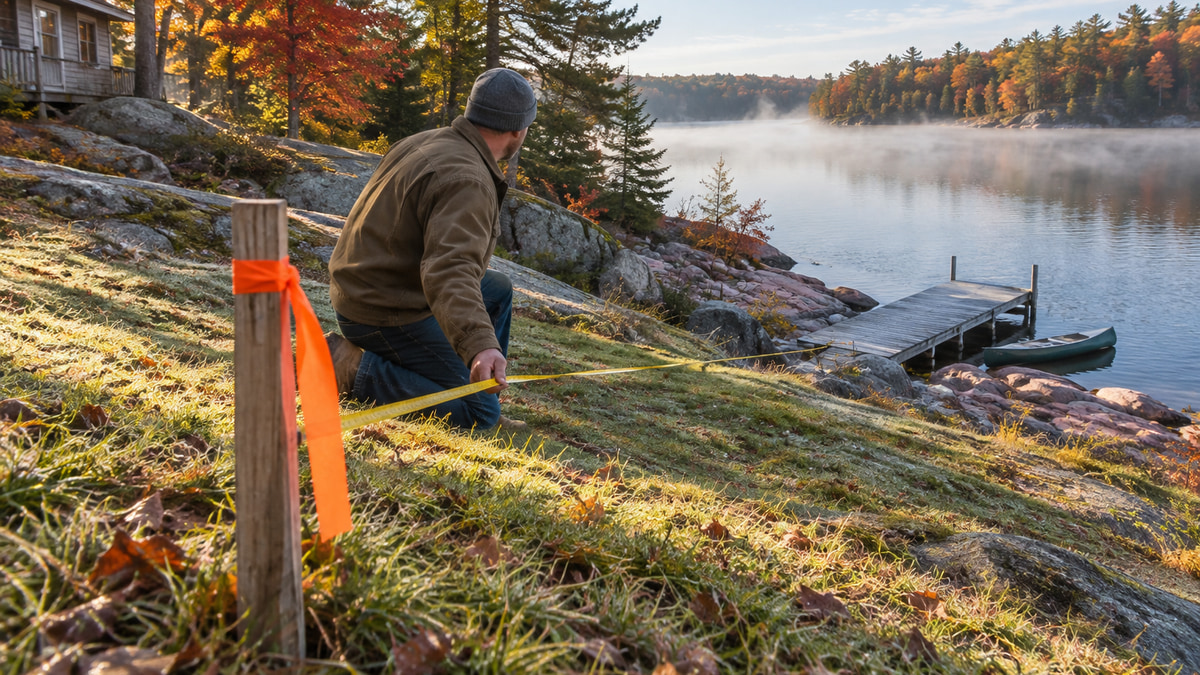
On a lot of Ontario lakes and rivers, the original Crown survey left a strip of land along the shore as a road allowance. It is usually described as 66 feet, or about 20 metres, wide. Unless it has been formally closed and sold, it is still a public highway in law, it belongs to the municipality, and the property you are buying may stop at its inland edge.
That can mean the lawn running down to the water, the dock landing and the shoreline itself are not part of the lot. In most cases it can be fixed by buying the strip from the municipality, but that takes a council by-law, a survey and usually months, so it is worth finding out before you firm up, not after you close.
What a shore road allowance actually is
When much of Ontario was first surveyed, the Crown laid out road allowances between lots and, in many townships, along the shores of lakes and rivers. Most of the shoreline ones were never built as roads. They stayed on the books as narrow strips of public land between the private lot and the water.
Ontario's Municipal Act, 2001 still treats them as highways. Section 26 lists all road allowances made by the Crown surveyors that are located in municipalities as highways, unless they have been closed. Section 30 says a highway is owned by the municipality that has jurisdiction over it. So an untouched shore road allowance in a township is, legally, a municipal road, even if it is grass, rock and cedar and nobody has ever driven on it.
Not every waterfront property has one. Whether a strip exists depends on how the original township was surveyed, and many owners or past owners have already bought theirs. That is exactly why it has to be checked property by property.
Why it matters when you are the buyer
If the allowance is still open, the property line usually sits back from the water, and the part of the yard most people are paying for is public land. A few practical consequences follow:
- Building and repairs. North Frontenac Township, for example, states that it will not issue building permits for structures on township-owned shore road allowances without proof of ownership. That reaches docks, decks, sheds and repairs to anything already sitting on the strip.
- Long use does not make it yours. Section 16 of Ontario's Real Property Limitations Act says the adverse possession rules do not apply to land in a surveyed road allowance where the freehold is vested in the Crown or a municipality. Apart from a narrow saving for rights acquired before June 13, 1922, thirty years of mowing it does not change who owns it.
- It is not private. Because it is a public highway, you cannot treat it as your own private shoreline or rely on keeping the public off it.
- Other rules still apply. Owning the strip does not replace conservation authority permits or shoreline rules. If the property is near a regulated area, the floodplain and conservation authority side is a separate question.
| What you see at the shore | If the allowance is still open | What to ask before you firm up |
|---|---|---|
| Lawn running to the water | Part of it may be municipal land, not part of the lot | Where does the deed description end, and is there a survey showing it? |
| Dock or stairs to the water | The landing may sit on the allowance | Has the strip been closed and sold, and is the by-law registered on title? |
| Shed, deck or boathouse near shore | Permits and repairs can be a problem without ownership | What does the municipality say about structures on its shore allowance? |
| Seller says “it's always been ours” | Long use alone does not transfer a road allowance | Is there a registered transfer, or only years of use? |
How to find out before it becomes your problem
None of this shows up on a showing. You find it in the paperwork, and the earlier the better:
- Get the survey. An up-to-date survey or reference plan will usually show a strip labelled as a road allowance between the lot and the water if one exists. If the only plan is decades old, read what an old survey can and can't tell you.
- Ask your lawyer to look for it specifically. A legal description that ends a measured distance short of the water, or a parcel register showing the municipality or Crown owning the adjoining strip, are the usual signs.
- Look for the closing by-law. Under section 34 of the Municipal Act, a by-law permanently closing a highway does not take effect until a certified copy is registered in the land registry office. If the seller says the strip was bought, there should be a registered by-law and a transfer to match.
- Call the municipality. Ask whether the allowance in front of that lot is open or closed, whether they sell shore road allowances, and what their current policy and fees are.
- Ask the seller directly. Whether they or a past owner ever applied, and whether anything on the strip was built with a permit.
Buying the strip from the municipality
Most townships will consider selling a shore road allowance to the abutting owner, but it is a council decision, not a form. The Township of Rideau Lakes guidelines in Leeds and Grenville are a good example of how it works locally:
- an application, reviewed by staff and circulated to agencies
- a recommendation from the township's planning committee and a decision by council
- if approved in principle, the township's solicitor searches title and a survey is prepared
- public notice and a public meeting, then a by-law if there are no valid objections
- the by-law is registered and the land is transferred once it is paid for
Rideau Lakes asks the applicant for a $4,000 deposit to the solicitor to cover legal, survey, appraisal and advertising costs, and says all costs of the process are borne by the applicant. Council weighs the public interest, including water access, so approval is not automatic. North Frontenac estimates its process at roughly 8 to 12 months. Fees, land prices and policies differ from one municipality to the next, so get the current numbers from the township that has the lot.
On some waterways there is one more layer. Section 34 also says a by-law permanently closing a highway cannot be passed without federal consent if the highway abuts land owned by the Government of Canada, including land covered by water. Whether that applies to a particular shoreline is a question for the municipality and your lawyer.
Don't plan on this being finished before closing.
A closing date a few weeks out is rarely enough time for a council process that can run most of a year. If an open allowance turns up during your conditions, the options are usually some mix of a condition, a price conversation, an agreement about who applies and pays, or walking away. Which one makes sense depends on the property and the wording in your agreement, and that is a conversation to have with your lawyer before you waive.
Where it fits with everything else on title
A shore road allowance is a title question, not a condition question. It sits alongside easements and rights-of-way as one of the things that decides what you are actually getting, and it is worth asking your lawyer how it is treated in your title insurance policy rather than assuming it is covered.
What I would do, buying on the water around here
If you are looking at a lake, river or St. Lawrence property anywhere between Ottawa and Brockville, a few habits save a lot of grief:
- Ask for the survey on day one, before you fall for the dock.
- Put the question to your lawyer in writing: does this lot run to the water, or is there an allowance in between?
- If there is an open strip, phone the township before you waive and ask what their process, timing and costs look like today.
- Treat the price of the strip and the time to buy it as part of what the property really costs.
Plenty of good waterfront still has an open allowance in front of it. It is usually solvable. It just should not be a surprise.
Looking at a waterfront property between Ottawa and Brockville and not sure where the lot actually ends?
Send me the address and whatever survey you have, and I will tell you what I would want checked before you firm up. Get in touch. No pressure either way.
Sources: Municipal Act, 2001, ss. 26, 30 and 34 (Ontario e-Laws); Real Property Limitations Act, s. 16 (Ontario e-Laws); Township of Rideau Lakes, Road Allowance Closure and Purchase Request Application (rev. January 2025); Township of North Frontenac, Shore Road Allowances. Statutes checked against the e-Laws consolidation current to October 1, 2026.
This is general information about shore road allowances in Ontario, not legal advice. Your lawyer and the municipality that has the lot are the ones who can confirm what applies to a specific property.