
Blog > Buying a House With a Basement Apartment in Ontario: How to Tell If It's Legal
Buying a House With a Basement Apartment in Ontario: How to Tell If It's Legal
by
A basement apartment is legal when it was built or converted with a building permit, the permit was closed with a final inspection, and the unit meets the fire and electrical safety rules. Zoning that allows a second unit is not the same thing as this particular unit being legal.
Before you firm up, ask for the permit records, check them with the municipality, and have your lawyer and lender look at the answer. A listing that says "income suite" or "in-law suite" does not tell you which kind you are buying.
Allowed and legal are two different questions
Ontario changed the rules in 2022. Under the More Homes Built Faster Act, municipalities have to allow up to three residential units on a residential lot with full municipal water and sewer: the main home plus up to two more units. In Ottawa, that means the main dwelling plus two apartments in the house, or one apartment in the house and one coach house.
That is the zoning side. It tells you a unit is allowed on the lot. It does not tell you the one in front of you was built properly. The City of Ottawa is clear that you need a building permit to add a unit, even when very little construction is involved. A unit someone finished on their own a few years ago can be sitting in a house where it would have been allowed, with no permit behind it at all.
A few things can change the answer before you even get to permits. The three-unit rule is tied to lots on municipal services, so on a well and septic the question is different and the septic capacity matters. And if the house is near water, check whether a below-grade unit is allowed in that area at all. I wrote about what a floodplain designation actually changes separately.
What makes a basement unit legal
For a new or converted unit, the province's guide to adding a second unit lists what the Building Code looks at: ceiling heights, room sizes, windows, plumbing, electrical, fire separation, smoke alarms and carbon monoxide alarms. It calls for a 30-minute fire separation between units. The electrical work needs its own permit and an inspection by the Electrical Safety Authority.
Older two-unit houses are also covered by the Fire Code's retrofit rules for two-unit residential occupancies. In plain terms, those rules look at:
- Fire separation between the two units, generally 30 minutes, or 15 minutes where smoke alarms are interconnected
- Smoke alarms on every level, including the basement, hardwired and interconnected so an alarm in one unit is heard in the other
- A way out: each unit needs a safe way out, and where a window is the second way out, it has to meet size and access standards
- Electrical safety: the fire department can involve the ESA, and hazards have to be corrected by a licensed electrical contractor
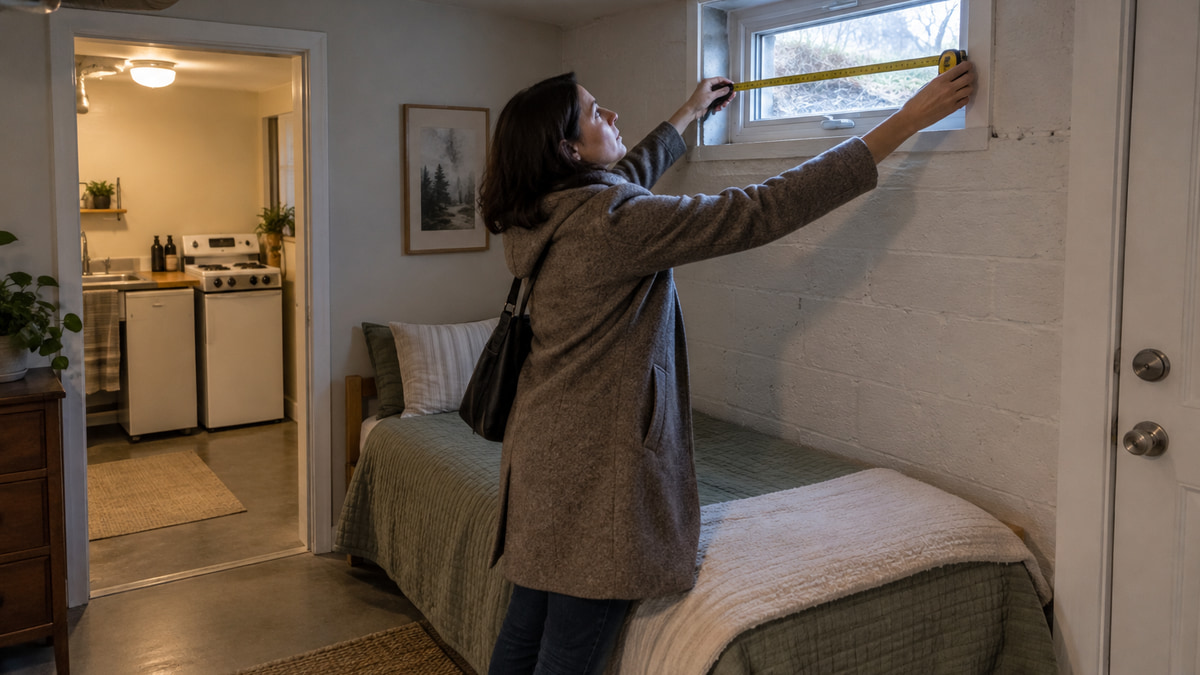
That window rule is why I pay attention to basement bedrooms. A small window up near the ceiling can look fine on a showing and still be a problem if it is the only other way out.
How to check before you commit
You do not need to become a building inspector. You need the paper trail, and a few people to read it with you:
- Ask the seller for the building permit for the unit and proof the final inspection was passed. "It was here when we bought it" is an answer, just not a helpful one.
- Check with the municipality. The building department can tell you what permits exist for the address and whether they were closed.
- Ask about ESA and fire inspections. If the unit was ever inspected by the fire department or had an electrical inspection, ask for the records.
- Tell your home inspector it is a two-unit house. A good inspector will look at the separation, alarms and exits, though an inspection is not a permit search. More on that in what a home inspection covers and what it misses.
- Talk to your lender early if you are counting on the rent. Ask how they will treat income from this unit before you rely on it. It is one of the things a mortgage pre-approval does not settle on its own.
- Call your insurer before you firm up and describe the house as it is. Insurers ask about secondary units, and I covered what insurers ask on older homes in more detail.
Permitted unit vs unpermitted unit
| What to check | Permitted unit | Unpermitted unit |
|---|---|---|
| Building permit | Issued for the unit, with final inspection closed | None, or one for unrelated work only |
| Fire safety | Fire separation between units and interconnected smoke alarms | Unknown until someone inspects it |
| Electrical | Work permitted and inspected by the ESA | Unknown, sometimes owner-installed |
| Insurance | Can be disclosed and insured as a unit | Disclosure may raise questions or cost |
| Rent in your mortgage plan | Easier to discuss with a lender | Ask the lender before you count on it |
| If you buy it | You inherit a documented unit | You inherit the work of legalizing it, or not using it |
Do not price in rent you cannot defend.
If the unit has no permit, the rent it earns today is not a sure thing tomorrow. Bringing it up to code can mean real construction, and some basements cannot get there at all. If the answer is not clear before your conditions run out, talk to your lawyer about how the offer should handle it.
If someone already lives there
A tenant in the basement changes the purchase too. In Ontario, an existing tenancy generally continues when the house sells, and ending it has its own rules and timelines under the Residential Tenancies Act. If you plan to move family in or use the space yourself, get your lawyer involved before you write the offer, not after. My piece on Bill 60 and what landlords and tenants need to know covers some of the recent changes.
None of this means a house with a basement apartment is a bad buy. A properly permitted unit can be a real advantage. The point is to know which one you are buying while you still have time to do something about it.
Looking at a house with a basement unit somewhere between Ottawa and Brockville and not sure what questions to ask?
Send me the listing and I will tell you what I would want to see before writing an offer on it. Get in touch. No pressure either way.
Sources: Government of Ontario, Add a second unit to your house; Ontario Fire Code, O. Reg. 213/07, Section 9.8 (two unit residential occupancies); City of Ottawa, Adding an apartment (additional dwelling units); BLG, Bill 23: the More Homes Built Faster Act, 2022.
This is general information about Ontario rules as of September 2026, not legal advice. Rules vary by municipality, so confirm the details for the specific property with the municipality, your lawyer and your lender.