
Blog > Buying a Home on Ottawa's Clay Soil: What a Big Tree Near the House Can Tell You
Buying a Home on Ottawa's Clay Soil: What a Big Tree Near the House Can Tell You
by
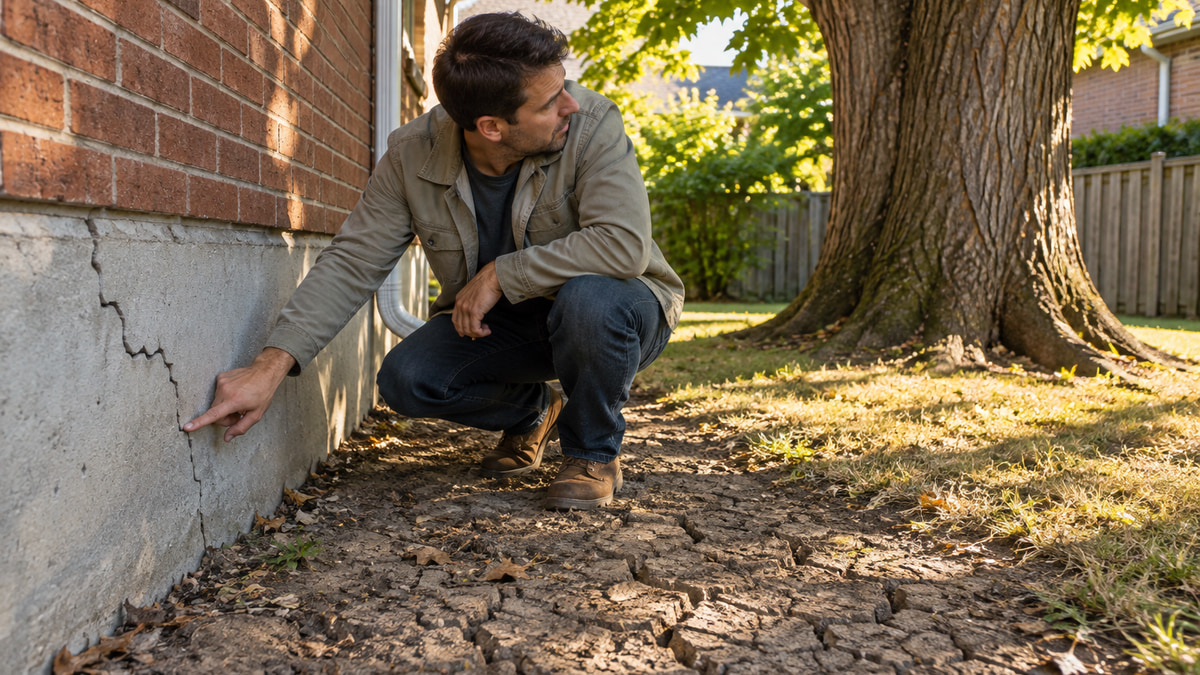
Parts of Ottawa sit on sensitive marine clay, a soil that shrinks when it dries out. A large, thirsty tree close to the house can pull enough water out of that clay to let a foundation settle unevenly and crack. If you are buying an older Ottawa home with a big tree near the walls, look at the tree, the crack pattern and the age of the house together, and bring in the right specialist before you firm up, not after.
What is Ottawa's "clay soil" problem, exactly?
The City of Ottawa calls it sensitive marine clay, and its own guidelines note the term is used interchangeably with Champlain Sea clay. It is a fine, water-heavy soil. A 2003 City report on foundation damage explained the problem plainly: clay can hold up to 70 per cent moisture, the water helps hold it up, and when that moisture is drawn down the clay shrinks in volume. Once it has shrunk, the report said, it cannot simply be "revived."
Shrinkage on its own is not the danger. Uneven shrinkage is. When one corner of a house loses support faster than the rest, the foundation takes stresses it was never designed for, and that is when you start to see cracking in foundation walls and sometimes in the walls above.
Why does a big tree near the house matter?
Mature trees drink a lot of water. The City's 2003 review named vegetation as one of four contributing factors, alongside a run of hot, dry years, more paved surfaces and uneven foundation loads, and found that mature trees were in some cases drawing more water out of the soil than rain and drainage put back.
That is why the City's tree planting rules on clay soils are built around distance. Under its 2005 clay soils policy, City trees in these areas had to be planted at least as far from a foundation as the tree's full mature height. The 2017 guidelines allow street trees in new subdivisions to be planted as close as 4.5 metres, but only for small and medium species and only when six conditions are met, including a soil test result below a set threshold and footings at least 2.1 metres below the finished grade. Large trees still need the full mature-height distance.
Those rules govern new City trees, not the maple your seller planted in 1985. But they tell you something useful as a buyer: the City treats a large tree within its own height of a foundation on this soil as a real risk. That is a reasonable lens for looking at a resale house too.
Where this has already happened in Ottawa
The 2003 City report traced foundation problems in Greenboro and parts of South Keys, first reported in the fall of 2001, to clay that had dried out after a run of hot, dry summers, mature trees and decades of new pavement. City staff warned the same thing could happen elsewhere in the city where similar conditions exist, roughly 20 years after an area is built. That timing is worth noticing: many homes that look "settled" are exactly the age where this can show up.
What should you look for when you view the house?
None of these signs proves a clay problem on its own. Together they tell you whether to dig further.
- The tree. How tall is it likely to get, and how far is the trunk from the foundation? A large tree closer than its own height deserves a second look.
- The crack pattern. Note where cracks are, which direction they run and whether they are wider at one end. Cracks concentrated on the side facing the tree are worth pointing out to your inspector.
- Doors and windows. Frames that stick or have been trimmed on one side can be a sign that part of the house has moved.
- The ground. Wide shrinkage cracks in bare soil near the foundation, or grading that slopes toward the house, are useful clues.
- The paperwork. Ask whether any foundation repair, underpinning or tree removal has been done, and whether a permit was taken out for structural work.
Will a home inspection catch it?
A general home inspection is a visual look at the house on one day. It can spot cracks and signs of movement, but it is not a soils investigation and it cannot tell you why a foundation moved or whether it is still moving. I go through the limits in more detail in what a home inspection in Eastern Ontario covers and what it misses.
If the inspector flags settlement and there is a large tree close by, the next call is usually a structural engineer, and sometimes a geotechnical engineer who can assess the soil. The City's own 2003 guidance told homeowners that rapid movement, or cracks or movement of about half an inch (1.25 cm) or more, was the point to bring in a structural or soils consultant. That is old guidance, but it is a sensible reference point when you are deciding whether a crack is cosmetic.
Foundation cracks are also not the only water-related question in an older Ottawa house. Basement flooding from the sewer side is a separate issue with its own fix, which I cover in backwater valves in older Ottawa homes.
Do not plan on cutting the tree down without checking first
Many buyers assume the fix is simple: take the tree out after closing. In Ottawa's urban area, a privately owned tree 30 cm or more in diameter at breast height on a lot of one hectare or less is a "distinctive tree" under the City's Tree Protection By-law, and removing it needs a permit. Removing a large tree is also not automatically a cure, since the soil under it changes again once the tree stops drinking. Get engineering advice before you decide, and confirm the permit rules with the City for the specific property.
How can you protect yourself in the offer?
The practical protection is time. An inspection condition gives you room to look properly, and if the inspection raises settlement near a large tree, you have a window to bring in an engineer before the deal is firm. Your lawyer can advise on wording if you want a specific right to have the foundation assessed.
It also helps to ask for what the seller already knows. Repair invoices, engineering letters and permit records for foundation work tell you far more than a fresh coat of parging does. If the house is older and the tree is big, ask early, before you are emotionally committed to the property.
Quick questions buyers ask
Does every Ottawa house with a big tree have this problem? No. Many homes sit near mature trees with no trouble at all. The risk depends on the soil under that particular lot, the depth of the footings, the size and type of tree, and how dry the years have been. That is why the answer comes from an assessment, not a rule of thumb.
Can I just water the tree? The City's 2003 advice to affected homeowners did include watering trees near foundations during dry spells, and pruning to reduce how much water a tree uses. It is maintenance, not a guarantee, and it does not undo shrinkage that has already happened.
Looking at an older Ottawa home with a big tree out front?
If something about a property is giving you pause, get in touch. Happy to walk through what to look at during the showing, how to use your conditions, and who to call if the inspection raises a question about the foundation.
No pressure, no obligation.
Sources: City of Ottawa, Tree Planting in Sensitive Marine Clay Soils, 2017 Guidelines and the guidelines document; City of Ottawa report Sensitive Marine Clays and Foundation Stress (May 26, 2003); City of Ottawa Tree Protection By-law information (by-law in effect January 1, 2021). Reviewed October 13, 2026. General information for Ontario home buyers, not engineering or legal advice. Have a qualified engineer assess any foundation concern and confirm tree permit rules with the City.