
Blog > Buying a Home on a Private Road in Leeds and the Thousand Islands: Who Plows, Who Pays, What You Can Build
Buying a Home on a Private Road in Leeds and the Thousand Islands: Who Plows, Who Pays, What You Can Build
by
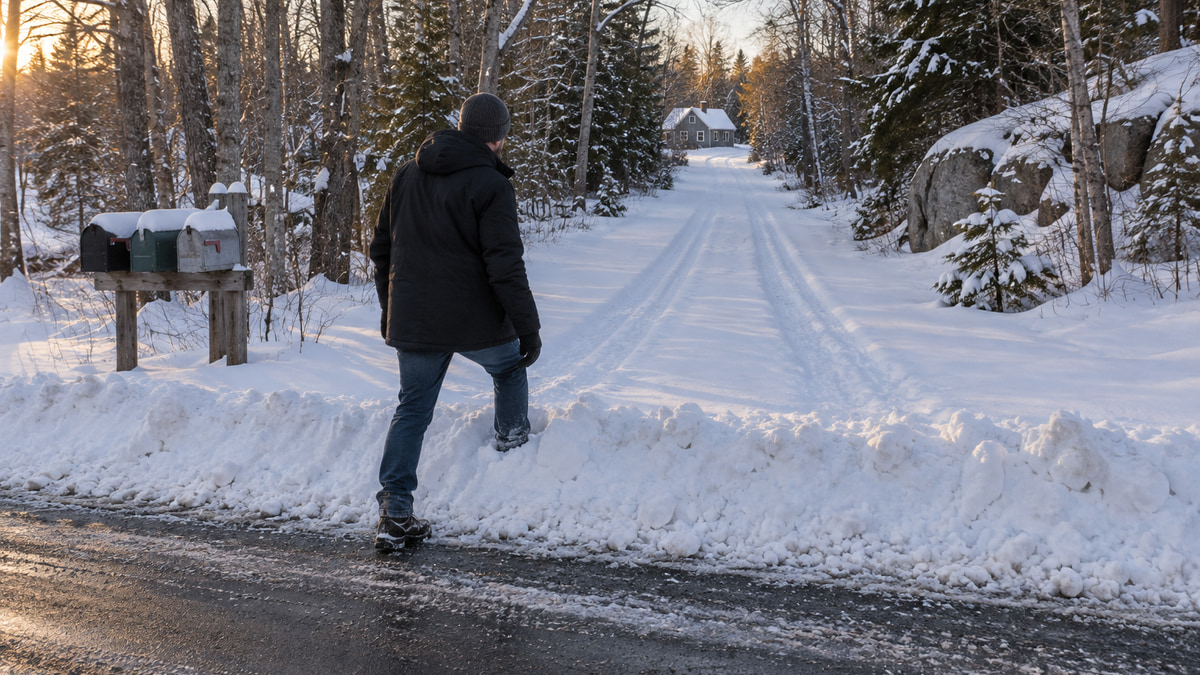
In the Township of Leeds and the Thousand Islands, a private road or lane is not plowed, graded or repaired by the Township or the County. The owners who use it look after it, usually through a road association, and the Township offers a small per-kilometre grant to associations that qualify. Before you firm up on a home or cottage on a private lane, find out who maintains the road, what it costs each year, whether your access is written into the deed, and how the Township's zoning treats building on a lot that does not front a public road.
Who plows a private road in Leeds and the Thousand Islands?
Not the Township. Its winter maintenance page says it plainly: private roads are not maintained by the Township or the County, and residents on them should hire a contractor or arrange winter maintenance with their neighbours. The Township's road ownership page puts it the same way: private lanes are maintained by citizens or lane associations.
The Township's own winter operations run from November 1 to March 31 on the roads it does maintain. On a private lane, the season, the plow contractor, the sand and the summer grading all come down to whatever the owners on that lane have arranged. On some lanes that is an organized association with a contract and annual dues. On others it is one neighbour with a tractor and an understanding that everyone chips in. Both can work. You just want to know which one you are buying into before you own it.
Who pays, and how does the Township's private road grant work?
The owners pay. The Township does help a little through its Private Road Grant, which has two streams: one for capital improvements such as emergency vehicle access, safety and drainage, and one for maintenance costs such as brushing, grading, snow removal and dust control. Grants are calculated per kilometre and depend on the budget Council approves each year. Maintenance applications are due October 31, with funds awarded the following spring. Capital applications close on the first Friday in June, and capital funding is not retroactive.
The useful part for a buyer is who can apply. Under the Township's maintenance grant policy, only private road associations are considered. The road needs at least two residences on it, the association has to represent at least two thirds of the residents who depend on the road for access, and it has to hold at least an annual general meeting, keep a bank account in the association's name and keep minutes of its meetings. If the lane you are looking at has an association that meets those tests, that tells you something about how organized the upkeep is. If it does not, nobody is collecting that grant, and the full cost sits with the owners.
Questions to ask about the lane before you firm up
- Is there a road association, and can you see its last annual meeting minutes and its budget?
- What are the annual dues or shared costs, and have there been any special levies for culverts, gravel or ditching?
- Who plows in winter, under what arrangement, and how early in the morning is the lane usually open?
- Is there a written road maintenance agreement, or is it informal between neighbours?
- Does the association apply for the Township's Private Road Grant?
- Is your right to use the lane registered on title, and does it run all the way from the public road to this property?
- Are there any disputes between owners about the lane right now?
Can a neighbour block a private road?
Ontario's Road Access Act gives some protection here. It covers access roads, meaning roads on land that is not owned by a municipality and is not a public highway, that serve as a motor vehicle route to one or more properties. Under the Act, no one can put up a barrier that cuts off all road access to other people's land unless a judge has ordered the road closed after notice, the affected owners have agreed in writing, the closure is temporary for repairs, or it is a single closure of no more than 24 hours in a year to prevent prescriptive rights.
That protection is about closing the road. It is not a maintenance agreement and it does not tell you who pays to plow or repair it. Your legal right to cross someone else's land to reach your property is a separate question, usually answered by a registered right-of-way. I go through how those work, and where they show up on title and on a survey, in easements and rights-of-way in Ontario. Your lawyer is the right person to confirm what is actually registered for the property you are buying.
Can you build or add on if the lot is on a private road?
This is the question buyers ask too late. The Township's zoning by-law has a section titled Frontage on an Improved Street, and it defines an improved street as a municipal road the Township has assumed and maintains on a regular year-round basis, or a county road or provincial highway. A private road, which the by-law defines as a privately owned street serving two or more lots, is not an improved street.
In practice that means a lot reached only by a private lane can be treated differently from one on a Township road when you want to build. If your plans include a new garage, an addition, a bunkie or replacing the existing cottage with something larger, ask the Township's planning and building staff how the frontage section applies to that specific lot before your conditions expire. The answer depends on the lot's history and zoning, so I would not rely on what a neighbour was allowed to do.
A summer showing can hide a winter problem
Most cottage and rural showings happen when the lane is dry and easy. If you plan to live there year-round, ask how the lane handles spring thaw and a big snowfall, and whether delivery trucks, fuel trucks and emergency vehicles get in without trouble. The Township's capital grant exists partly to improve emergency vehicle access on private roads, which tells you it is a real consideration, not a hypothetical one.
Quick questions buyers ask
Will the Township take over the road if we ask? The Township's road pages describe private lanes as the owners' responsibility and point owners to the grant. They do not describe a process for taking over a private lane, so do not buy on the assumption that it will become a Township road.
Is a private road a reason not to buy? Not by itself. The Township runs a grant program for private road associations, which tells you these lanes are a normal part of the area. The difference between a good one and a headache is usually how well the upkeep is organized and how clearly the access is documented.
Does this only apply in Leeds and the Thousand Islands? The specific rules above are that Township's. Neighbouring municipalities around Brockville set their own road, grant and zoning rules, so check with the municipality where the property sits. If you are coming from Ottawa and still weighing the area, my buyer's guide to moving from Ottawa to Brockville covers the bigger picture.
Looking at a property on a private lane?
If you want help working out what to ask before you write an offer, get in touch. Happy to talk through the road, the access and the conditions that make sense for that property.
No pressure, no obligation.
Sources: Township of Leeds and the Thousand Islands, Snowplowing and Winter Maintenance, Road Ownership and Responsibility, Private Road Grant Policy and Application, Private Road Grant Policy (Maintenance), By-law 15-046 and Zoning By-law 07-079, office consolidation January 4, 2023; Government of Ontario, Road Access Act, R.S.O. 1990, c. R.34. Reviewed October 17, 2026. General information for buyers, not legal advice. Confirm current grant deadlines and zoning with the Township, and ask your lawyer what access is registered for the property.