
Blog > Buying an Ottawa Home With a Pool in the Off-Season: What to Check While It's Closed
Buying an Ottawa Home With a Pool in the Off-Season: What to Check While It's Closed
by
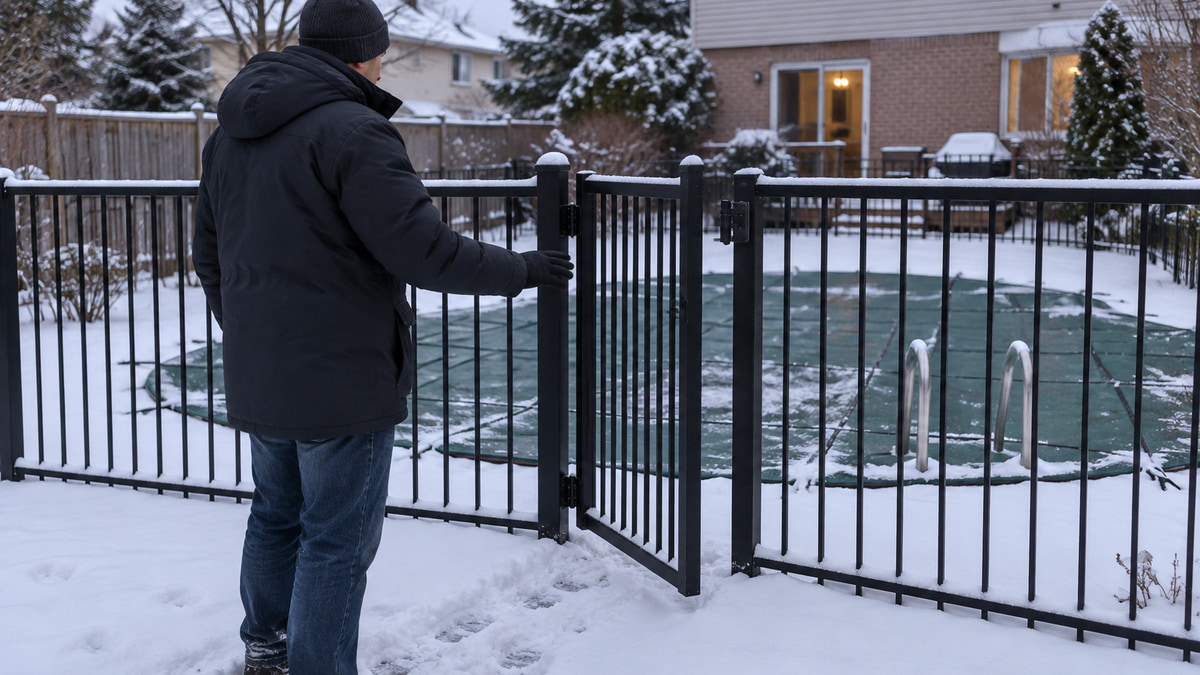
When you buy an Ottawa home with a pool between fall and spring, the pool itself is usually closed under a cover, so you cannot see much of it. What you can check is the part the City regulates: the fence and gates around it. In Ottawa every pool enclosure needs a permit, and every gate has to close and latch on its own and stay locked when the pool is not in use.
The most useful step is to ask for the City's Pool Enclosure Compliance Report, which pulls the permit and inspection records and includes an inspection of the existing enclosure. Get it, or a clear plan for it, before your conditions run out.
What do Ottawa's pool rules actually cover?
The City of Ottawa's Pool Enclosure By-law (No. 2013-39) applies to privately owned outdoor pools that can hold water 600 mm deep or more at any point. The City's pool enclosure page says that includes ponds, blow-up and self-inflating pools, and hot tubs.
Every pool enclosure needs a permit, including a replacement enclosure. The City is specific that a yard that already has a fence still needs a permit for the pool, so the permit can confirm that fence actually meets the pool rules. A regular backyard fence and a permitted pool enclosure are not automatically the same thing.
The main standards for a current enclosure are:
- At least 1.5 m (5 ft) high.
- No opening wide enough for a 100 mm sphere to pass through. Chain link mesh can be no larger than 38 mm.
- At least 1 m from the edge of the water.
- Nothing on the outside that makes it easy to climb, and a hedge does not count as an enclosure.
- Gates that are self-closing and self-latching, with a lock, and kept closed and locked whenever the pool area is not in use.
- An overhead garage door cannot form part of the enclosure.
What can you check in winter, and what has to wait?
A covered pool hides the liner, the shell, the water and most of the equipment. The enclosure is a different story. Here is how the two usually split when you are buying in the off-season.
| What to look at | Can you check it in winter? | What usually waits for spring |
|---|---|---|
| Permit and City records | Yes. The compliance report pulls the permit, inspection reports and any outstanding notices or orders. | Nothing extra, the records do not depend on the season. |
| Gates closing and latching | Usually. Open each gate and let go. It should swing shut and latch on its own. Snow or ice can get in the way, so clear it first. | A second look once the snow is gone, if ice made the first test unreliable. |
| Fence height, gaps and spacing | Mostly. You can see the height, the style of fence and any obvious gaps or damage. | Anything buried in deep snow along the bottom of the fence. |
| Hot tub cover | Yes. Look for a cover that locks, and ask whether the hot tub has a permit. | Nothing extra for the cover itself. |
| Pool shell, liner and equipment | Very little while it is closed. Ask the seller for the age of the liner, heater and pump, and any opening and closing records. | The real look, when the pool is opened and running. |
If you are booking a home inspection, ask the inspector ahead of time what they will and will not look at on a closed pool. Our guide to what home inspections in Eastern Ontario cover and miss explains why it helps to know the limits before inspection day.
What is a Pool Enclosure Compliance Report?
It is a City of Ottawa report you can request on a specific property. According to the City's compliance report page, it gives you information from available records on the pool enclosure permit, inspection reports and any outstanding notices of violation or orders. It also includes an inspection that checks whether the existing enclosure meets the rules, including whether the gates have self-closing, self-latching and locking devices.
A few practical details matter when you are working against a condition date:
- The fee listed on the City's page is $207. The City says to check its fee schedule for the current amount.
- The inspection needs the property owner's permission. As a buyer, that means the seller has to consent, and the City has a consent form for it.
- You can request it online through My ServiceOttawa or at a Building Code Services counter, with payment at the time of the request.
- The City's page does not give a turnaround time, so ask when you request it rather than assuming it will be back before your conditions expire.
Because of the consent step and the unknown timing, it is worth raising the report early, ideally when you are putting the offer together. How that is reflected in your agreement is a question for your lawyer.
What if the fence is older than the current rules?
The current by-law took effect in 2013. Enclosures that were properly permitted under the earlier rules, were in good repair and were in use on March 1, 2013 continue to be treated as compliant, with one exception. The requirement to keep gates closed and locked at all times when the pool is not in use applies to every enclosure, no matter when it was built. The City notes that this can be as simple as a padlock.
Two things change that picture. If the enclosure is replaced, the new one needs a permit and has to meet today's standards. And if the fence was never permitted at all, the older-enclosure protection does not help. That is why the permit record matters more than how solid the fence looks.
If the house also has a newer deck, addition or finished basement, the same records habit applies. Our guide on checking permits on a renovated Ottawa home walks through how to look those up.
Before you firm up on an Ottawa home with a pool or hot tub
- Ask the seller whether the pool enclosure has a City permit and when it was installed or replaced.
- Ask for the seller's consent to a Pool Enclosure Compliance Report and request it early.
- Walk the whole fence line. Open and release every gate and watch whether it closes and latches by itself.
- Check that every gate has a lock, and note any section where a hedge or a garage door is standing in for fence.
- For a hot tub, look for a cover that locks and ask whether the hot tub was permitted.
- Ask for the age of the liner, heater and pump and any opening and closing records, since you will not see them running.
- Talk to your lawyer about how the report and any fence issues should be handled in your agreement.
Common follow-up questions
Does a hot tub need a fence in Ottawa?
Not if it has a proper safety cover. A hot tub with a cover that meets the by-law's standard, is permanently attached and is locked whenever the hot tub is not in use does not need a fence. The City is clear that a permit and inspection are still required. A hot tub without a compliant cover falls under the same fence and gate rules as a pool.
Who is responsible for the enclosure after closing?
Once you own the home, keeping the enclosure in shape and the gates locked is your responsibility as the owner. The City can issue orders to correct an enclosure, including emptying the pool until it is fixed, and fines on conviction start at $500. That is a big part of why it is easier to sort out the paperwork before closing than after.
Do you need a new permit if you replace the fence?
Yes. A replacement enclosure needs a permit and has to meet the current standards. Repairing parts of an existing permitted enclosure does not require an upgrade to the new standards, but the gates still have to be kept locked.
Looking at an Ottawa home with a pool this winter?
Happy to help you work out what to ask for before you firm up. Get in touch. No pressure either way.
Sources: City of Ottawa, Pool enclosures; City of Ottawa, Pool Enclosure By-law No. 2013-39; City of Ottawa, Pool Enclosure Compliance Report. All were read November 20, 2026.
By-law requirements and fees change. Confirm current rules and fees with the City of Ottawa before you rely on them, and get legal advice on your agreement.